it's time for 3 music posts. first on the menu: muxtape meets iTunes for your online music needs. if you haven't already heard about this new it-toy, you should look into it. it hasn't converted me from iTunes yet, but it has me poking around and it's definitely worth the curiosity invested.
the short of it:
6 million tracks (+counting). you can listen to any song once for free; no "thirty second preview." currently there are no ads and no subscription fees. just sign up and listen. if you want to listen again, you pay based on what you're licensing for... web only is 10 cents, mp3 download is 79--cheaper than iTunes. if you already own a song, they 'move' it to your purchased tracks for free. 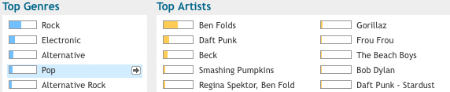
oh and yeah, there's that social aspect where you can add friends, and a last.fm style graphic aspect where i know what kind of style of music a person is into on a sliding scale. it also has this "CD trading" feature you can do, but i don't know what that is yet. and for what it's worth, so far they seem to have most of the stuff i've looked for, including my more esoteric choices. okay, they didn't have Emily's Sassy Lime, but at least they knew the band existed.
and so forth...
so this is being hailed as something of a breakthrough in music distribution. i mean, it's cheaper, and that's a plus, but since it's newer, it's not as integrated. i will need more time before i surrender the awesome that is iTunes. it does seem like a step forward from last.fm and muxtape, merging the social with the purchasing directly, as well as offering a space for all of it to be held purely online if one should so desire. this is a plus for organizational types and i'm sure a few other 'types' as well; the lack of a subscription fee with an iTunes-like purchase system is just an added bonus.
10.29.2008
you make me wanna... LaLa.com?


10.15.2008
you could give up all your worldly possessions
interlude -- aka that thing i do when i'm not directly talking about advertising/social media/marketing. instead, this post is dedicated to Blog Action Day, inspired when i read Advergirl's response. really, go read it. because she did it well and i'm not going to head in the same direction.
the theme this year is poverty. Advergirl gives examples of hands-on ways you can change poverty in the world around you. i think that's the point of the action, but i want to talk philosophically instead. i want to talk about the word possession. not its roots, but its context. because i think the root of poverty is our concept of possession. i'm not going to tell you to give up all your worldly possessions. we all need stuff. duh. that's kinda the point of poverty actions. to help people who don't have stuff get stuff. so yes, in essence, i'm pro-stuff.
but the concept of ownership--of possession--of items or of people has been tripping me up lately. i've been thinking a lot about infidelity, no small part in thanks to AV Flox [on the person-level] and on the corporate-level [that's just one link, hat tip to Gavin]. and also about ownership literally. like in the beginning of Fight Club where the narrator's apartment, his whole life basically right down to his treasured Ikea furniture, goes up in flames. and he has nothing.
"it's very easy to take more than nothing" -- Mad Hatter [Lewis Carroll]
if we think of ourselves as owning nothing, then everything we have is its own gift, come to us by way of the world, into our laps, and can go just as swiftly. letting go becomes easy. giving becomes easy. after all, what is it to you, who needs nothing, and can always have more than nothing? why do you not give? what are you saving for? what do you think you own? what do you fear to lose? what do you fear?
you get upset when someone leaves you because you thought you owned some part of them. that they for a moment might become a part of you. and that fear encroaches on many relationships. fear of cheating, fear of abandonment, fear of emotional distance, etc. you get upset when an object breaks, when you lose a stock, when hours are cut. i'm not saying any of those are unrealistic fears. i'm saying, comparatively, you would feel less stressed if you were less concerned with your territory, your ownership.
because right now, if you own up to the fact that you own nothing, you still "have stuff." you've changed your thought patterns but not your life, and that's alright. i'm not saying become a recluse and get out of every relationship because you can't have any true security in it. you don't have to go become a monk, but next time you can give, you might think of it as a little easier. easier to give more than nothing. and more thankful for those moments in which others give to you--a new sweater, an hour spent, a moment of intertwined fingers.
[disclosure: in my ugliest state, i am an intensely territorial creature. i am that jungle predator in my head, i like the idea of ownership and i can be incredibly defensive about it. a poem i wrote in college had the line "i would piss on tree bark just to prove it's not yours"; a paraphrase but still true. things belong to me because they have become a part of me. "you are not your fucking khakis" -- palahniuk. i am working through this. i am learning what it means not to own. i am good at giving. i am trying to be better.]
7.23.2008
the stone gods, revisited.
alright, if you're a frequent reader of my blog, you may have noticed my references to "the stone gods" every now and then. it's actually a book by Jeanette Winterson, a wonderfully difficult current English writer. my favourite author, in truth. even though, like her other novels, it deals on some level with love triangles, gender roles, time variance, and other nuances of plot, i frequently find a lot of it relevant to advertising, marketing, and PR. that could also be because it's a futuristic book (see excerpt here, with the tour of the Blue Planet).
as i touched on briefly with the issue of transference in music, many things are becoming increasingly intangible as we move forward. American Shelf Life touched on this briefly with regards to money (and the decreased use of bills) but did not consider the same implications. it's something that the main character, Billie, in the Stone Gods had to deal with. all of their money was "theoretical" in the sense that ours is (with regards to cards). they had Credits.
problem with things you can't touch, that you can't own? problems with releasing data, this thing you can't take back? you don't know, can't control, where it goes. Billie falls into disfavour with the government. the Credits she "has" suddenly disappear. she can't park her car, her house is taken away. sounds familiar, right? like some case of stolen identity. except there's no law to protect that. any records of transference, done without her permission, have been deleted. as a friend once said in his blog, "What makes you think that because something is written down on a piece of paper it becomes true?"
i love this future we have coming. but in this theoretical space, i also have no issues around my own transparency and my own fear for it. i do use my debit card far more than cash. i had those same experience @SarahHutton described. but so what happens if our money becomes Credits? does that make you feel safer? or does it not concern you; does it not matter? i'd really be interest in the thoughts outside my own head on this one.
6.24.2008
why i still buy CDs. & the issue of transference.
"Last April, Microsoft met with criticism when it announced that it would deactivate all music purchased from MSN Music." more at my legal love, the EFF.
as we move more and more digital, we will be experiencing ownership risks. i'm not talking copyright. i'm talking unabashed cynicism. i'm saying as money becomes credits and CDs become digital--as these things are subjected to hacking, crashing, burning, and who knows what else--we are going to be faced with the dilemma of easy transference. when something intangible goes "missing" who owns it?
for an easy example. i purchased for my mother a Starbucks iTunes card which would theoretically have enabled her to download, via iTunes, the entire new Duffy album. i spent tangible cash on it. she goes home and it won't download. now, yes, the iTunes reps have been very helpful. but that's not the point. the point is, it's not in her purchase history--so she can't report a problem on it. it's not downloaded somewhere odd on her hard drive, and yet, it says it's already been redeemed. where did my $14 go? to a little 5x7 plastic card with some musician in chiaroscuro on the front.
now with things like MSN threatening to "deactivate purchased music" by 2011, what happens with that? it was purchased. ownership was transferred. and yet, they are able to legally retract that. purchase not valid after X date. sounds like a library to me--and yet there was a monetary exchange. where did that go? if you can't hold your music in your hands--do you own it? have you purchased it? or just lent a big company some cash? in a way it reminds me of folks paying real dollars for intangible World of Warcraft objects.
"DRM-crippled music still has an expiration date –- whenever the company that sold that music becomes unable or unwilling to continue supporting the copy protection."
but hey. maybe that's just my affinity for the stone gods talking.
6.20.2008
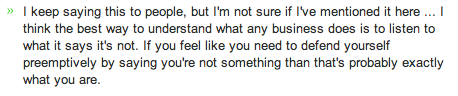
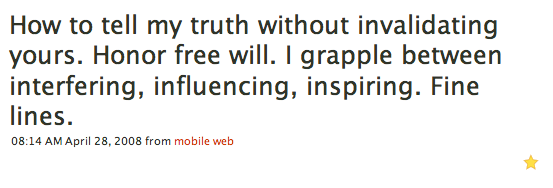
bits of wisdom.
--Noah Brier
and a story between the lines: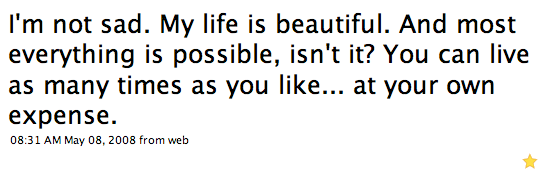
--A.V. Flox // Evelyn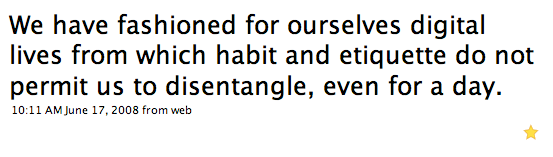
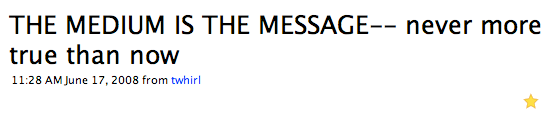
--Joel // Alisa
[some of my 'favourites' starred from twitter]
5.16.2008
save me from this world:
If you like, you may live in a computer created world all day and all night. You will be able to try out a Virtual life with a Virtual lover. You can go into your Virtual house and do Virtual housework, add a baby or two, even find out if you’d rather be gay. Or single. Or straight. Why hesitate when you could simulate.
And sex? Certainly. Teledildonics is the word.
(Jeanette Winterson, Written on the Body, p. 97)
is there a person in the house?
NO. NO NO NO NO NO NO NO NO. AND... NO?
"In other words, if everything else in a consumer's life is connected through digital, shopping should be, too."
if i want to be alone and not interact with people when i shop, I SHOP ONLINE.
i don't need to get on a car, in a subway, on a train, to go visit a store without people. granted, it's "less employees," not "no employees," but what's the difference? those people who still are employed will find better ways to "use the time" they're being paid for than to perform customer service, which requires patience, effort, and understanding. why do that when a computer can do it for you? besides, it's not like we need more jobs available anyway...
can i keep saying NO any more?
how many times do you call a phone of a company now and get into an endless automated loop about some stupid thing you never wanted to tell them just because you can't get a HUMAN on the phone? a human who could have answered your question in 2.5 seconds? i don't want to stare at a screen to discern my purchasing protocol. if i'm not doing it online i a) want a personal opinion about the product or b) i procrastinated and need said item NOW, at which point i'm not asking any questions anyway: my mind is made up. removing employed people from stores is a surefire way to lose traffic to said store. they could just buy online.
we are already disconnected. we are seeking connections via pixels. welcome to the age of mass communication. mass disillusionment. mass isolation. and you're just making it worse rather than fostering those connections. if anything, this technology should be a tool used by employees to help customers. like the computers in Borders or Wawa or your local tech-savvy deli. but for the love of interaction and humanity, don't lose the people. sometimes i leave the house just to see another face.
beware the stone gods.
4.15.2008
'the stone gods' and why it matters.
i am that lit geek.
my 100th tweet [don't ask, i don't really care the number] was about Jeanette Winterson's The Stone Gods. i didn't even know. woo! personal landmark. i'm such a winterson dork.
anyway, the tweet was:
"strange question: have any of you read The Stone Gods by Jeanette Winterson?"
why is this fiction book important? everyone's twittering about ad:tech, and @alisamleo was talking about:
adtech: "are people getting freaked out" by individualized, behavioral targeting?
>> 39 minutes ago from web
adtech: well....depends on the age group. younger users don't care, its the internet economy...
>> 38 minutes ago from web
which got me thinking about how i'm still a little weirded out by it. i don't know if it's generational (am i not considered a young user anymore? i'm only 22) or just that i'm aware of what's going on; either way, i am still cautious about individualized targeting--even as i advocate it (see previous posts about choosing what our txt ads should be in order to keep relevance high).
The Stone Gods is similar in concept to other futuristic books. if you've read Margaret Atwood's The Handmaid's Tale, The Stone Gods is pretty much the direct inverse combined with Brave New World. among other themes, The Stone Gods addresses characters in a world that is hyper-marketed, hyper-targeted, and hyper-relevant. the computers know what you want before you do, right down to what you should wear (i'm sure Kenny Cole would love that -insert eyeroll here-). everything was so individualized that everyone began to be similar anyway, but it was what was desired regardless.
question posed: effective, yes. useful, perhaps.
but is this the kind of world you personally would want to live in?
no judgments here. i'm just honestly curious if you believe it would be beneficial, easier, and less stressful, or if it would "freak you out" about privacy etc.